Design First, Sustainability Always: Inside My Interior Design Process
If you know anything about my business, you know sustainability is a top priority for me. In this blog post, I’m sharing more about my process and practices surrounding design and sustainability, tradeoffs and considerations, and some ways you can make more informed decisions on your own home. There are a couple of real-life examples at the end that I hope will prove to be helpful for you!
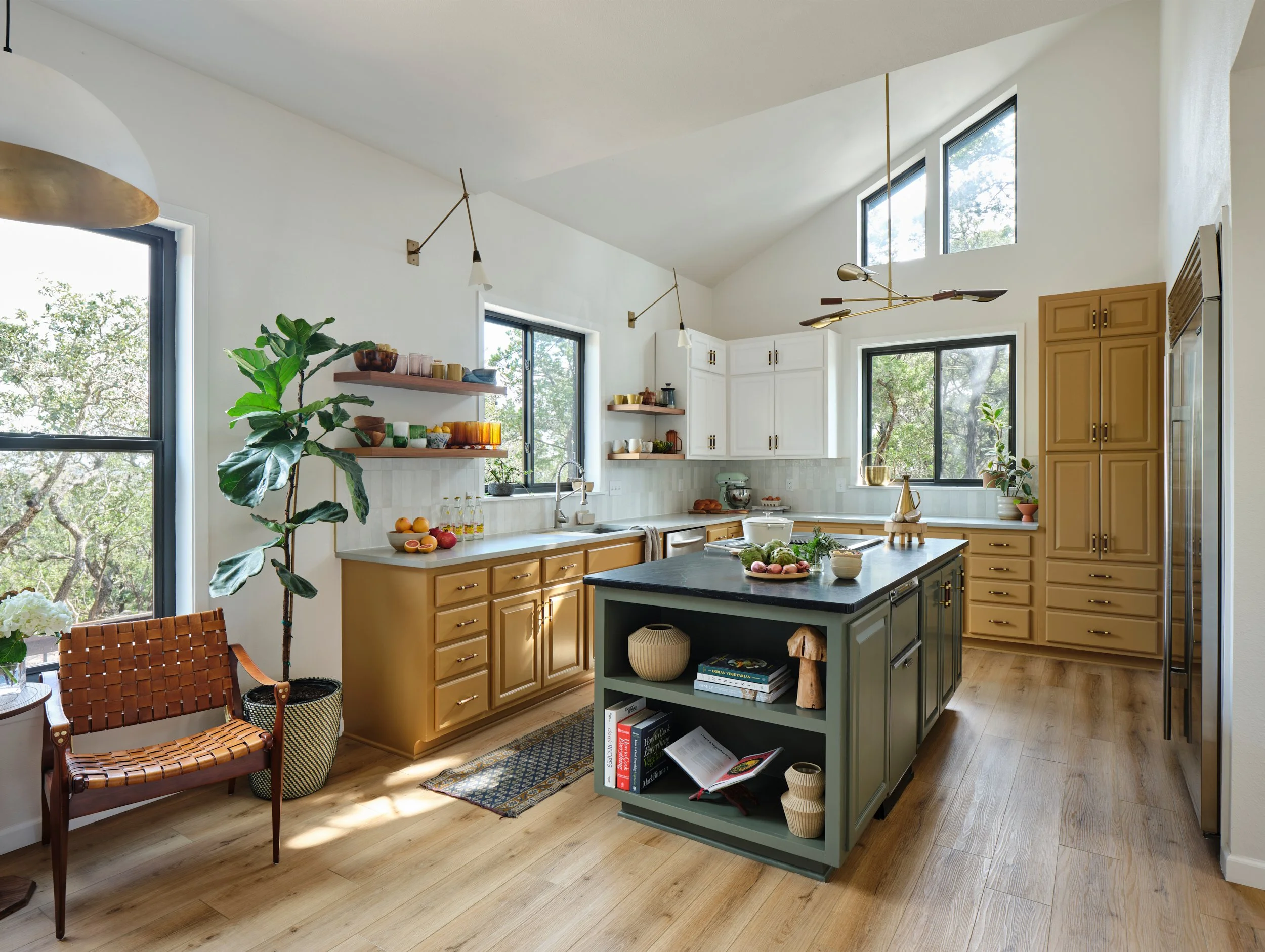
Kitchen cabinets repainted rather than replaced, furnishings and rug sourced through consignment/antique stores, and all items on shelving (plus most of the remaining styling items) meets one of the following criteria: thrifted/second-hand, handmade locally, or purchased from a local small business.
Let’s start with some of the basics. Sustainable design seeks to:
Reduce waste
Conserve resources
Promote the health of homes and the people who live within them
Source materials that are:
Biodegradable
Reclaimed
Recycled
Recyclable
Natural
Free from harmful chemicals
Promote longevity and durability in selections
Maintain, repair, and extend the life of products
Promote fair labor practices
When it comes to designing spaces, I lead with the design. The functionality, feel, and design details are always first. Once I have a design concept in place, I source from the most sustainable options I can. You can’t necessarily tell by looking at a well-appointed space that it’s sustainably designed.
Sustainability is NOT a design style.
You don’t have to limit yourself when it comes to the design, while still having a space that’s mindful of the environmental impact. Good design is sustainable design, in that every detail has been thoughtfully considered and breaks the cycle of overconsumption. When your home is designed well, you don’t feel the need to redesign it every 5 years.
Once I have a design concept in place and I’m moving forward with making final selections, this is my list of priorities and considerations when sourcing:
Can I source vintage and antiques for the project?
This means no new materials or production costs
They emit little to no Volatile Organic Compounds (aka VOCs, gases emitted that easily evaporate and can cause health issues)
This diverts waste from landfills
Oftentimes, these pieces are higher quality
If sourced locally, this requires less in transportation costs
What can I keep/repurpose that already exists in the space?
This reduces waste, costs, and can create a more personalized, layered feeling. Reminder, the design is always first. So, I only keep things that will support the overall vision.
If purchasing new, can I source from companies that have solid manufacturing processes? I look for certifications such as:
Certified B Corp (meet standards of social and environmental performance, ethical and sustainable sourcing practices)
Forest Stewardship Council (aka FSC, promotes sustainable forest management)
GREENGUARD (evaluates product emissions and certifies strict indoor air quality standards)
OEKO-TEX (tests and certifies textiles to assess safety for consumers and planet)
GOTS (global organic textile standard - assessed based on several key factors)
There are so many more!
I frequently look to the Sustainable Furnishings Council (SFC) directory to find businesses that prioritize sustainability. I am proud to be a member of the SFC.
The quality of construction, ensuring each furniture piece will stand the test of time
Circularity: What happens at the end of the product’s lifecycle? Can any part be recycled, upcycled, or is it biodegradable?
Local sourcing from small businesses creates reduced carbon emissions and energy usage
progress over perfection.
Let’s be honest here, you can’t make a perfect decision. The perfect decision in terms of the planet is to live with what you already have forever and buy nothing. I’m not promoting that, obviously, I’m an Interior Designer and it’s my job to create beautiful functional spaces. That does mean getting rid of things that are no longer serving you and replacing them with “new” pieces. That said, the above list is a starting point in making better decisions.
when you know better, you can do better.
Let’s dive into a couple examples as an exercise. In each example, I’ll share what I’m sourcing, and I’ll give an example of what I would consider a good option and why. NOTE: None of the products mentioned are sponsored. This is just an example of a process I might take to get to a final selection.
Example 1: Mattress
I’m working on redesigning a client’s bedroom, and they’re switching from a queen bed to a king bed, and they’ll need a new mattress to go along with their bed. We will need to purchase something brand new, so the whole second-hand/vintage/antique step is obviously out of the picture.
The first thing I’ll check out is the Sustainable Furnishings Council (SFC) to view a more narrow list of companies that prioritize sustainability. Is every company focused on sustainability in here? Nope! But it does make my job a little bit easier as a start. In their member directory, I see a couple of mattress companies listed. Of those, the one that appears to have the most strict guidelines for health, safety, and environmental impact is called Naturepedic. They are certified in several areas: Global Organic Textile Standard (GOTS), Global Organic Latex Standard (GOLS), Environmental Working Group (EWG), Forest Stewardship Council (FSC), MADE SAFE, GREENGUARD Gold, Organic Content Standard (OCS), Responsible Down Standard (RDS), Responsible Wool Standard (RWS), and more than is worth listing for this purpose (you get the picture). You certainly can’t say this company is greenwashing - they’ve done the hard work, and they have a thorough environmental commitment standard.
All of that said… Are they going to be comfortable for my client? All the certifications are great, but I need to make sure my clients can actually sleep well. For my Dallas area clients, you’re in luck, because there are three showrooms in your area. For those who are further away, they offer free shipping, a free 100-night trial, and free returns. I’m finding that most people aren’t going into a mattress store anymore to try out mattresses in person, anyway. People seem to be buying more online and having them delivered. Many mattress companies are offering a trial period, where you can send it back for free if you’re not happy with the comfort level.
A note on switching out mattresses: Before putting your old mattress in the bulk trash pickup pile or taking it to the dump, please search for mattress recycling programs like Bedder World. I will say, I have not personally recycled a mattress through them, but it seems to be a much more sustainable way to get rid of an old mattress than sending it to the landfill! Some mattress companies will also take old mattresses for recycling into other products.
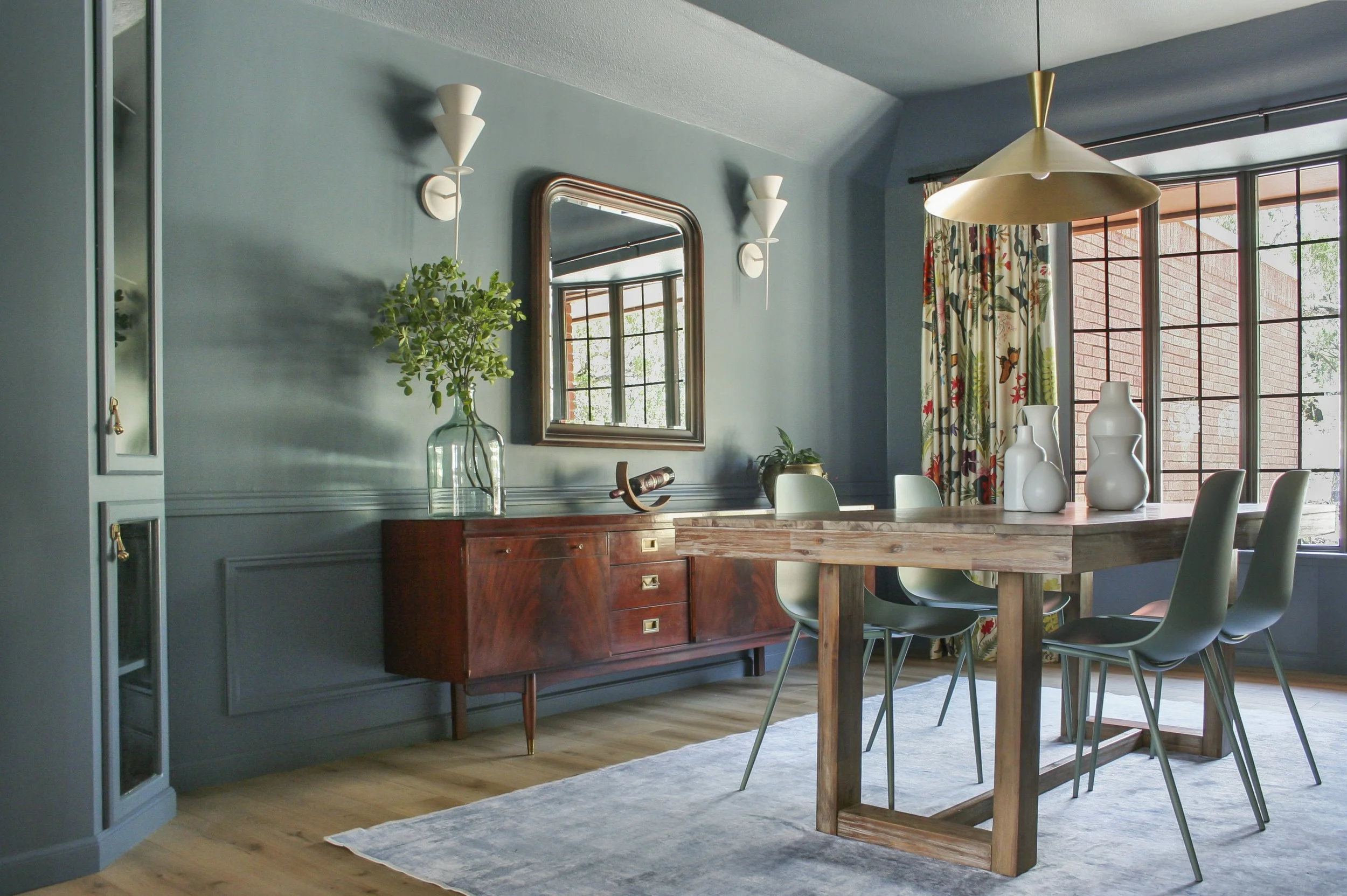
Sourced a second-hand table, vintage cabinet, and mirror for this dining room refresh.
Example 2: Dining Table
My client is moving into a new home and their old dining table does not fit the space of their new dining room. The first thing I’ll do is encourage them to sell or donate their old one. It breaks my heart when I see people plop furniture on the side of the road for bulk pick up, and then it rains, damaging the piece, and no one picks it up. Come on, y’all!! You know I had to rant about something.
Anywho… once I’ve got a design concept in place (always first!) and I know the size, shape, style, and color I’m looking for, I start searching at local vintage and antique stores, auctions, and consignment stores. A vintage or antique dining table is most likely going to be better quality than something you can buy off-the-rack, and I’m always going to try this route first, especially for furniture pieces that don’t include fabrics. If I’m not able to find something locally, I’ll open up my search online as well. For online vintage (always more expensive this way, though), I like: Rejuvenation, Etsy, John Robshaw, Chairish, 1st Dibs, to name a few. If I get to the point where I’ve exhausted my resources and I’m not finding something I’m loving for my client that’s vintage or antique, I’ll start looking for new items. This is not at all an exhaustive list, but here are a few examples:
I will typically start with trade-only companies that I have experience with that have prioritized sustainability. Because their business model is selling to trade professionals, rather than for mass production to end consumers, I’d consider many of them to be heirloom quality (something you’d pass down to future generations). There are several I really like that have solid sustainability practices.
There are many large, well-known furniture companies that are prioritizing sustainability now, too. Again, this is not sponsored. Here are a few and what to look out for:
Room & Board: They have some great sustainability practices, and they’re very clear about what they’re doing (“We aim to use 100% sustainably sourced wood by the end of 2025”). They have thoughtful and specific goals they’re working towards. They’re a Certified B Corp and have published impact reports.
West Elm: While they certainly aren’t perfect, they do have ways now to search for more sustainable options within their inventory. You can search for items that are sustainably sourced or GREENGUARD certified. On individual product pages, it will share the product’s sustainability features.
CB2: Same comments as West Elm above. They have a landing page that allows you to search for products based on your sustainability priorities.
Crate and Barrel: Here’s their landing page.
Greenrow: Each product has sustainability features listed.
When all else fails, choose something that’s of high quality and is a sturdy piece that will stand the test of time. Some companies don’t prioritize certifications and sustainability necessarily, but they build quality products that will last you a lifetime. That, to me, is still a more sustainable option than a lot of what’s on the market right now.
One thing I think is important to note, I don’t source only from companies that have it all figured out and have a million certifications under their belt. I also support companies that are transitioning to more sustainable practices. Progress > Perfection. I think the important piece here is making sure they aren’t just including statements for the sake of marketing. They need to have some tangible goals in place and communicate clearly how they’re intending to make their manufacturing processes and materials more sustainable. You can tell the difference between these two statements:
“We’re committed to designing more sustainable furniture and to improving our impact.”
“By 2030, we will use 100% renewable electricity in our operations.”
One of those statements could possibly just be fluff for the sake of selling products, while the other is very specifically working toward tangible goals that make a difference.
I really could include so much more on this topic, and share a laundry list of places I like to shop, but I think that could easily become overwhelming! I also know that this topic is ever-evolving, and more and more companies are prioritizing sustainability. This is by no means an exhaustive list, but I hope it’s helped provide some guidance on how best to systematically design a space sustainably.
As I finished this blog post, I realized I didn’t dive into materials and sustainability (ex: why wool is my go-to material for rugs). This may need to be a two-part series! Is that something you’d be interested in learning more about? If so, leave me a comment below! If you’re interested in some sustainable swaps for everyday living (like kitchen and bath products), check out this previous blog post.
And of course, if you find this all overwhelming or you don’t feel like you have a “design eye,” but a beautiful and sustainable home is important to you, you can always work with me to update your home!