How To: Mixing Design Styles
I often get asked on Instagram about how to mix two different design styles successfully. This one felt like more of a blog post than an IG story response, so I decided to expand a little bit further here than I could in a smaller space on IG.
Oftentimes, this question comes up because a couple has very different styles and they are having a hard time agreeing on the details of their home decor, furnishings, and renovations. While this topic could turn into a full-blown book, I’m going to try and keep it as short and simple as I can. First, I’ll give you some overall tips that apply to all styles, and then we’ll dive deeper into a couple of real-life examples.
General Tips
Tip 1: Embrace diversity
A home with one singular style/perspective is often really boring. Embrace the fact that having more than one dominant style will likely result in a more interesting home. It'll look more collected, feel unique, and it will tell your personal story. If you overdo one particular style, you run the risk of your home feeling one-note.
Tip 2: Be curious
Try to approach the conversation about your partner's style with curiosity rather than with an end goal in mind. You may find some commonalities to work with. Trust me, it is totally possible to create a beautiful home that you’re both happy with, without someone feeling like they lost the battle.
Tip 3: Study images together
Make it a date night! Both of you take some time to pull together images of interiors you each love. Maybe even go to a bookstore and look through magazines and design books. Schedule a time to show the spaces to each other, taking turns showing the images and explaining what you like about them. Talk about how specific elements reflect your personal style, pointing out all of the little details. While one person is sharing, the other just listens.
One thing I’ve noticed in working with clients is that many people don’t actually have the vocabulary to describe what they like, so photos help a ton. You may find that your partner isn’t able to communicate their style effectively, so there’s just a misunderstanding.
Tip 4: Compromising isn’t losing
If you're disagreeing on a major furniture purchase, like a sofa, remember: your sofa won't be the only thing in the room. The styling really makes a huge difference in how the room looks and feels. Understandably, the big arguments are typically over the pricier items. You are less likely to disagree over small items.
Tip 5: When all else fails, hire someone to help!
Sometimes it helps to have a third party weigh in. An interior designer should be able to work with all styles, blending a home that feels personalized to you and your spouse. At the end of the day, we want both of you to be happy with your home. If you just feel like you aren’t able to get where you want to be, there’s no shame in asking for help!
It would be kinda dumb not to put this button here…
Real Life Examples
Example #1:
While these are made-up scenarios, they are based on my experience with real-life clients and their partners.
Let’s say one partner says their preferred style is midcentury modern, while the other says theirs is rustic.
My suggestion would be to first distill those two styles into their most foundational/basic form and notice the characteristics.
Midcentury modern is all about clean lines, geometric shapes, organic curves, and minimal ornamentation. An indoor-outdoor connection is common, and sometimes bold colors. Furniture is generally very practical and uncluttered feeling.
The foundational characteristics of rustic style emphasize natural materials and a focus on comfort. This design style prioritizes a warm, rugged, and unpretentious atmosphere. Wood, stone, and metals are common. Textures and textiles include leather, wool, cotton, and chunky knits. Furniture is typically sturdy, well-made, and functional, with little ornamentation.
Once you read through those descriptions, do you notice some commonalities? While you may not envision those two styles having a ton of similarities, they really do. Clean lines with natural materials work perfectly here. Rather than using “midcentury” and “rustic” in your search terms, perhaps you search for things like:
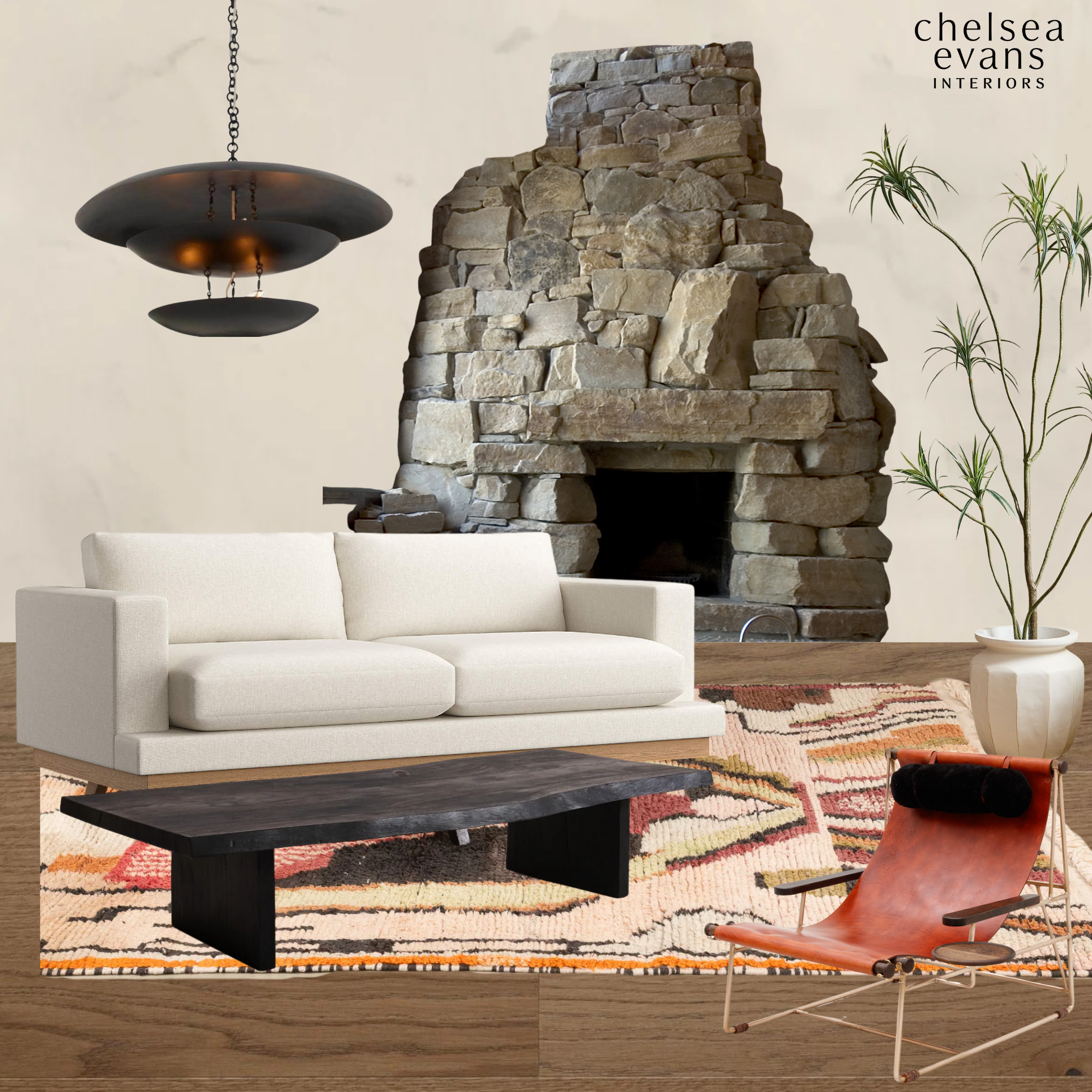
Natural Stone Fireplace
Modern Wool Shag Rug
Leather and Wood Sling Chair
Primitive Wood Coffee Table
Modern Wrought Iron Chandelier
Casual Sofa Clean Lines
Sculptural Potted Tree
Medium Tone Wood Floors
Here’s a quick mood board using those search terms. Feels midcentury meets rustic to me! There’s still tons of room to add styling touches to lean more in one direction or the other. For example, maybe add some midcentury artwork or a classic midcentury lamp if it’s feeling too rustic for your liking. That coffee table needs styling - that’s a good opportunity to add more as well. Feeling like you want to lean more into the rustic aspects? Add some textiles and layering to the sofa. You picking up what I’m putting down?
Example #2:
Alright, so you might think I was using too easy a combination in example 1... Maybe your partner loves modern, and you feel like your style is giving more Grandma Chic. Rather than comparing them to find similarities/common ground, in this case, I’d totally embrace the tension and drama of combining the two. A home that’s 100% modern or 100% Grandma Chic is honestly pretty borrrrrrring.
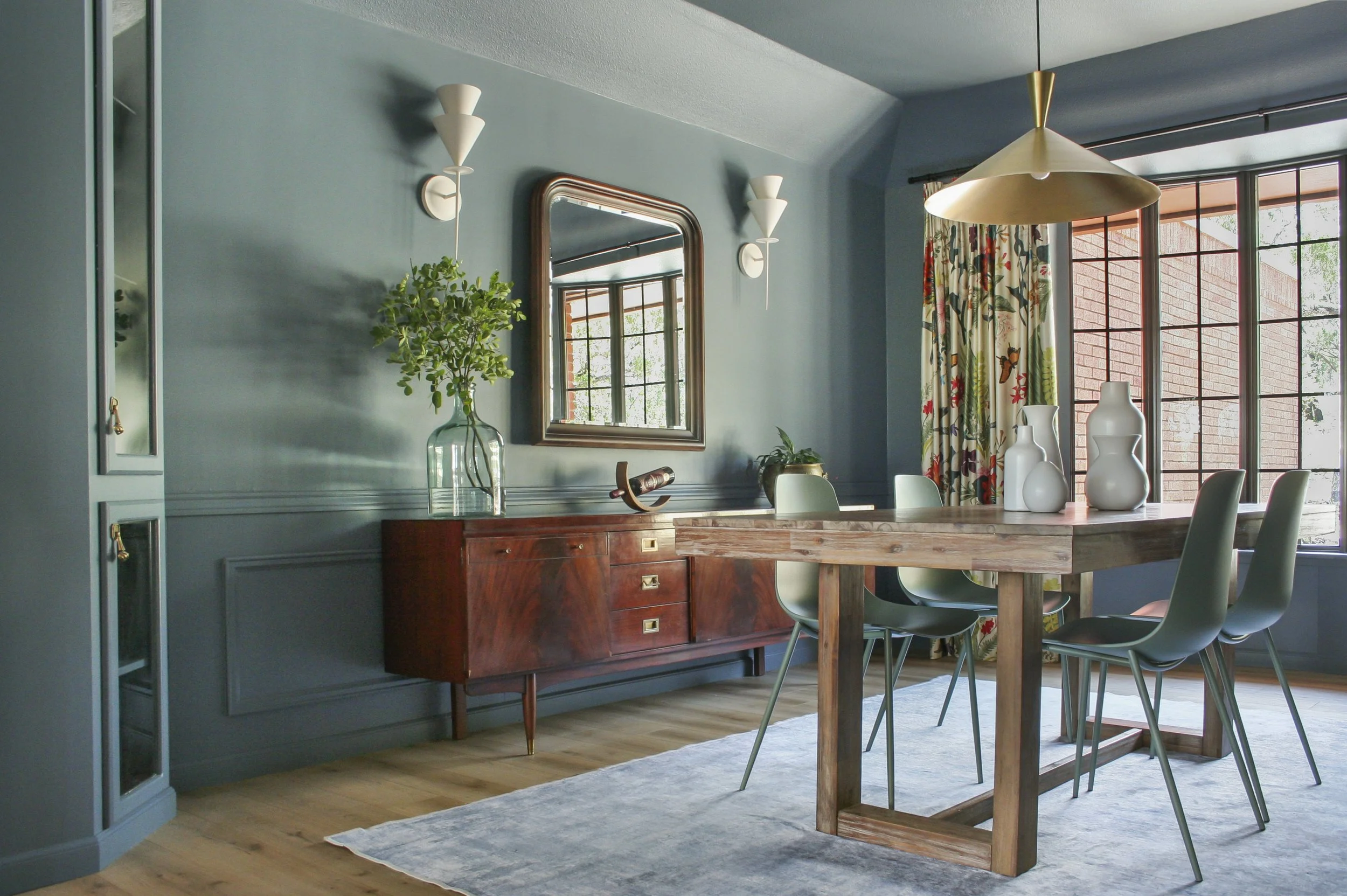
In a lot of ways, I feel like my home is a mixture of Grandma and modern, so I’ll use that as my practical example. I tend toward clean lines in my main furniture, with minimal detail, but I balance that out with more detail in styling and architectural details. I might opt for a sofa with clean lines, but pair that with an ornate antique drink table. In my dining room, I have a table and chairs that are all clean lines with minimal detail, but the room has bold floral drapes and some more traditional moulding and trim. Example below:
If you’re embracing the tension of your two drastically different styles, I’d recommend not making decisions in isolation. Otherwise, it will always feel like a battle where someone’s winning and someone’s losing. Instead, craft the entire room together visually before ordering items.
Let’s say you need a new sofa. Don’t just go out and buy a sofa. Make a plan for the entire room. Perhaps your partner wins the sofa debate, but you win the drapery and coffee table debate, and you’re both happy with the result. If you’re trying things out with a mood board rather than with your actual finances, you can take a more playful approach and have fun with it. Try to keep the attitude of “let’s just try it and see!”
Let me know in the comments if you relate to this post. Do you and your partner have very different styles? How would you describe your style and theirs?